

Tattoo Reference Card Checklist: What to Bring to Your Artist
Make a useful tattoo reference card with verified wording, placement ideas and focused notes. Know what the card communicates and what your artist still decides.
Quick answer
Bring one clear design reference, verified wording and a short explanation of what matters. Mark size and placement as preferences to discuss; a reference card is not a professional transfer stencil.
A tattoo reference card gives your artist a focused starting point. It brings the visual idea and a few useful notes together, so you can explain what you like without sending a long, contradictory collection of images.
The card does not replace a consultation, a professional stencil or your artist's final design work. Its value is clarity: what is essential, what is flexible and what still needs a decision.
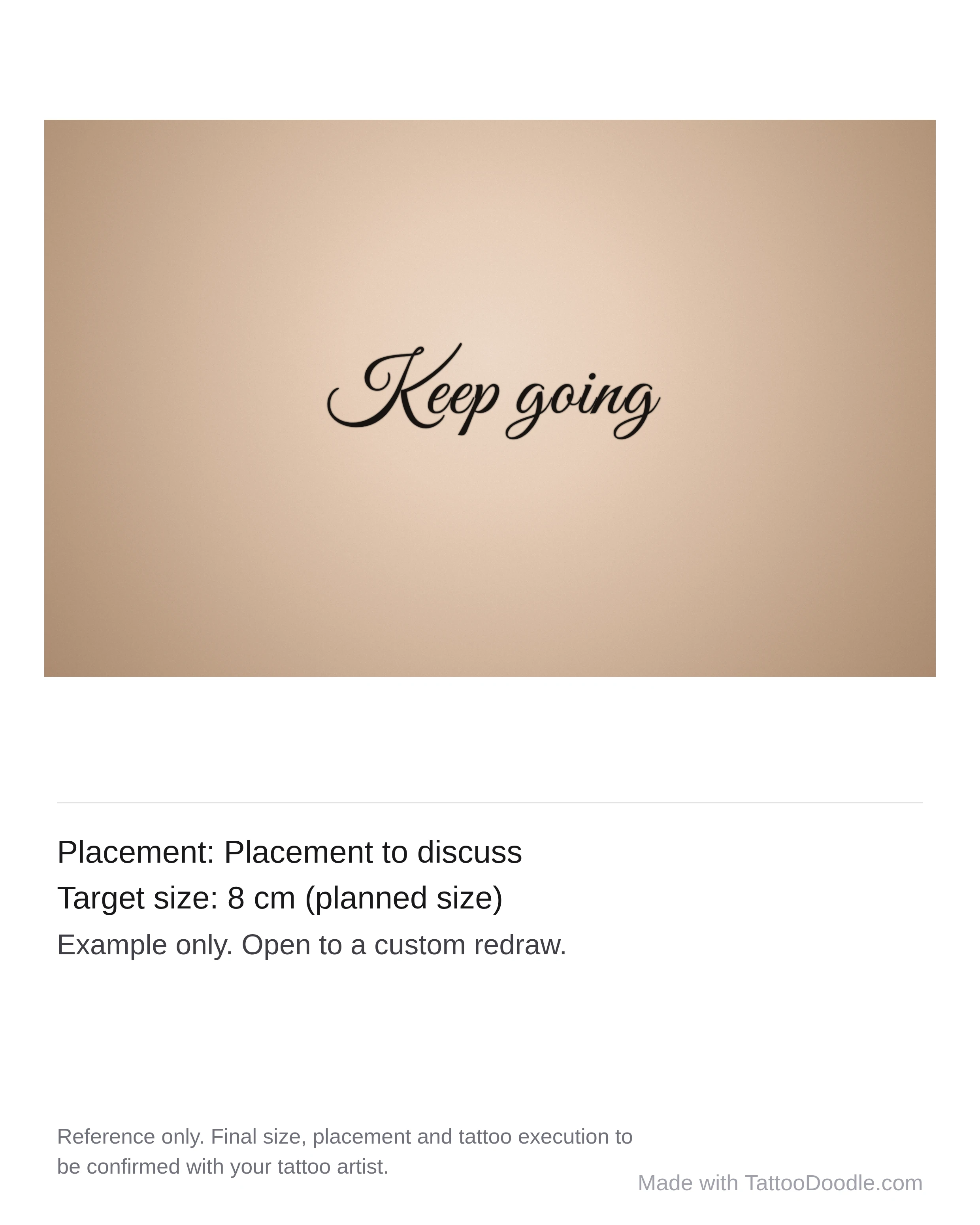
An actual exported reference card made with example lettering and demonstration notes. Planned details are discussion points, not instructions for tattoo execution.
Start with one main reference
Choose the image that best represents the direction you want. If you have alternatives, keep them separate and explain the difference. For example, one might communicate the lettering style while another shows a preferred balance of open space.
Do not combine unrelated designs simply to fill the card. A short explanation of why you chose one direction is often more useful than a crowded collection with no clear priority. Label inspiration and your own proposed wording distinctly.
Verify words and numbers outside the image
Keep a plain-text copy of any name, phrase, date or coordinates beside the visual reference. Check spelling and digits against a trusted original, and ask another person to review them. Decorative letters can hide a mistake that would be obvious in plain text.
For another language or writing system, seek a qualified wording check. The card generator does not verify a translation, cultural meaning or geographic location. Review any revised version again after the design has changed.
Describe placement as an idea
A note such as "considering the inner forearm" tells your artist where to begin the conversation. It does not settle how the artwork should wrap, face or relate to your movement. Be prepared for the final composition to differ from a flat reference image.
If you add a planned size, make clear that it is a preference. An image's pixel dimensions are not an exact physical-size guarantee. Avoid presenting a number from an online preview as a professional instruction.
Use notes to identify priorities
Choose a few points your artist can act on: "keep the wording unchanged," "prefer the simpler capital" or "open to a custom redraw." Separate those priorities from optional details. If everything is described as essential, it becomes harder to discuss adjustments.
Avoid technical promises about how the tattoo will heal or how much detail must fit in a particular space. Ask your artist to evaluate those questions rather than writing the answer into a reference card.
Make and check the actual export
In the lettering studio, choose your wording and select Make a reference card. The current card form includes placement, planned size, color preference and notes. You can then download the card as a PNG.
Open the saved file and check that the design and notes match what you intended. Keep the original wording available separately. The tattoo templates guide explains why a design reference and a professional transfer stencil serve different roles.
Send the card as a conversation starter, not as a demand that every detail be copied. A clear reference leaves room for your artist to interpret the idea and explain the final choices.
Make your own
Explore a tattoo concept with the AI generator (free usage is limited), preview lettering with the free font tool, or try a placement preview. AI design references are not professional tattoo-ready stencils.