40 Tattoo Ideas for Women: Delicate, Bold, and Everything Between
Searching for tattoo ideas for women? Explore 40 ideas across fine-line, floral, script, and bold styles, plus a placement guide and three practical tests to try before you commit.
Quick answer
The best tattoo ideas for women balance personal meaning with smart placement. This guide collects 40 ideas — from one-inch fine-line symbols to full floral sleeves — plus a placement-by-pain guide and three practical tests to run before you book your session.
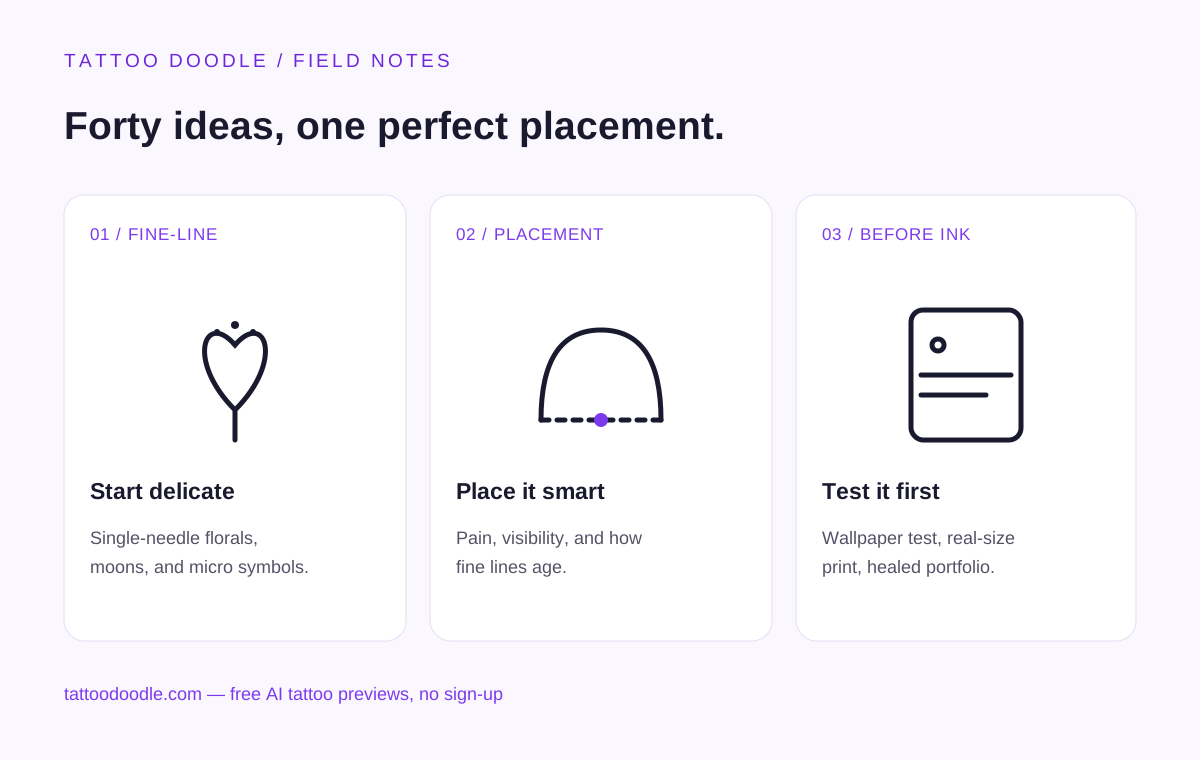
Finding tattoo ideas for women that feel personal — not generic flash off the wall — takes more than scrolling a gallery. The design matters, but placement, size, and how the lines will age matter just as much. Below are 40 ideas organized by style, followed by the practical part most idea lists skip: where to put it, how much it tends to hurt, and how to test a design before it becomes permanent.
Fine-Line & Minimalist Ideas (1–8)
Fine-line tattoos are the most requested style for women right now, and for good reason: they read as jewelry, they heal fast, and they fit almost anywhere.
- Single-needle wildflower stem — One continuous stem with two or three leaves. Beautiful at 2–3 inches on the forearm or collarbone.
- Tiny crescent moon — A half-inch curve behind the ear or on the wrist. Simple, and it pairs well with a second small piece later.
- Minimalist mountain line — Three peaks in one unbroken line. A quiet nod to travel or resilience.
- Dot-work constellation — Your zodiac constellation in dots and hairline connectors. Works along the spine or ribcage.
- Small paper crane — Folded-crane geometry in fine line. Symbol of hope, sized for the ankle.
- Thin-line wave — A single curling wave for surfers and ocean lovers. Inner wrist or ankle.
- Micro heart outline — Not filled, just the contour, about the size of a fingernail. Finger or wrist.
- Fine-line dragonfly — Delicate wings with detailed veining. Shoulder blade or thigh.
Floral & Botanical Ideas (9–16)
Florals remain the most versatile category — they scale from a one-inch sprig to a full sleeve, and they suit every placement on the body.
- Lavender sprig — A vertical stem that follows the natural line of the forearm, spine, or calf. One of the most forgiving designs for first tattoos.
- Peony in blackwork — Dense, dramatic petals. A statement flower for the thigh or upper arm.
- Cherry blossom branch — Flowing across the shoulder or along the ribcage. Ask your artist to let branches wrap the body's curve rather than sitting flat.
- Eucalyptus branch — Curved stem with round leaves. Elegant on the calf or outer arm.
- Wildflower bouquet — Mixed stems, loosely arranged — not a formal bouquet. Forearm or thigh.
- Single rose, fine-line — Contour only, no shading. Timeless and easy to place anywhere.
- Fern frond — Detailed single leaf. Lovely as a standalone piece or as filler between larger tattoos.
- Ivy vine wrap — A climbing vine that wraps the wrist, ankle, or bicep. The wrap effect hides the "sticker" look that flat designs can have.
Symbols With Meaning (17–24)
Symbolic tattoos carry weight in a small footprint. Pick symbols whose meaning you can explain in one sentence — if you can't, keep looking.
- Moon phases row — Five small phases arcing along the collarbone or spine. Represents cycles and change.
- Semicolon — A widely recognized mark of mental-health resilience. Keep it small: wrist or behind the ear.
- Unalome — The Buddhist-inspired spiral-to-line symbol for life's path. Traditionally placed along the spine or sternum; research its meaning first and wear it respectfully.
- Lotus — Growth through difficulty. Dot-work petals add texture without adding size.
- Butterfly — Transformation. A realistic monarch on the shoulder reads very differently from a fine-line outline on the wrist — same symbol, two personalities.
- Snake — Rebirth and shedding old skin. A fine-line snake following the spine is one of the most striking placements for this symbol.
- Hamsa hand — Protection. Palm-sized on the back of the shoulder or as a sternum piece.
- Anchor — Stability. Classic, compact, and it ages well because the shapes are bold.
Script & Word Tattoos (25–30)
Word tattoos live or die on typography. Script that looks good on a screen can blur at tattoo size, so always have your artist redraw the lettering by hand at the exact size it will be inked.
- "Breathe" in fine script — A wrist reminder. Keep it under two inches so the letters stay legible.
- Coordinates of a meaningful place — Latitude and longitude in a clean typewriter font. Ribcage or forearm.
- A single word in your grandmother's handwriting — Scan the actual handwriting and have the artist trace it. No font matches the real thing.
- "Nevertheless, she persisted" — Ribcage or thigh. Long quotes need a large, flat canvas — don't squeeze this onto a wrist.
- Date in Roman numerals — Anniversaries and birth dates. Simple, private, and it never goes out of style.
- Two-line poetry fragment — Pick the two lines, not the whole stanza. Collarbone script works when the lines are short.
Bold & Statement Pieces (31–36)
Not every woman wants delicate. Bold pieces use thicker lines and solid black, which also means they age the best — thick lines hold their shape for decades.
- Floral half-sleeve — Peonies, roses, and leaves from shoulder to elbow. The most requested large piece for women, and it photographs beautifully.
- Back piece: crane and moon — A Japanese-influenced composition across the shoulder blades. Needs 2–3 sessions; plan for it.
- Thigh botanical panel — A vertical garden of stems and flowers. Easy to show or hide.
- Blackwork moth — Detailed wings spread across the sternum or upper back. Gothic, dramatic, unforgettable.
- Geometric wolf — Angular facets forming a wolf's face on the calf or forearm.
- Full forearm floral wrap — Flowers and leaves circling the whole forearm. Reads as a sleeve from a distance, but it's one continuous piece.
Tiny & Hidden Ideas (37–40)
For workplaces, family events, or simply privacy — small tattoos in concealable spots.
- Inner lip or behind-the-ear star — Genuinely tiny. Note that inner-lip ink fades fast; treat it as temporary.
- Finger dot or ring band — A single dot at the base of a finger, or a thin band around it. Hands get a lot of sun and washing, so expect touch-ups.
- Ankle bracelet vine — A thin vine circling the ankle. Reads as jewelry from a few feet away.
- Hip-bone script — One word along the hip line. Completely private unless you choose to show it.
Placement Guide: Pain, Visibility, and How Lines Age
Pain is not equal everywhere. As a rough rule: outer upper arm, outer thigh, and calf are the least painful common placements; inner arm, ribs, sternum, spine, feet, and hands hurt noticeably more. If this is your first tattoo, start somewhere forgiving — you can always go bolder on piece number two.
Think about visibility in both directions. A wrist tattoo is visible to you every day, which is wonderful if you love it and exhausting if you stop loving it. Ribcage, thigh, and back pieces are for you first and the world second. Neither choice is better; just make it deliberately.
Fine lines age faster than bold lines. This is the trade-off nobody puts on the flash sheet: that hairline-thin minimalist design will soften and spread slightly over the years, while bold traditional lines hold crisp for decades. Mitigate it with sunscreen (tattoos fade fastest with UV exposure) and by asking your artist to go one needle-size thicker than the absolute minimum for the design.
Three Tests to Run Before You Commit
1. The 30-day wallpaper test. Set the design as your phone wallpaper for a full month. If you're still excited on day 30, it's a keeper. If you're bored by day 10, you just saved yourself a laser-removal consultation.
2. The real-size print test. Print the design at the exact size it will be tattooed, tape it to the placement spot, and look at it in a mirror from six feet away. Tiny details that look great zoomed-in on a screen often disappear at real size — this test catches that before the needle does.
3. The healed-portfolio test. Don't judge an artist by fresh tattoos; everything looks good fresh. Ask to see — or find on their social media — photos of their work healed after six months or more, in the exact style you want. An artist whose fine-line work still looks crisp healed is worth waiting for.
Preview Your Design Free
Still torn between two or three ideas? Generate a preview of each before you decide. Our free AI tattoo generator at tattoodoodle.com renders your description — try "fine-line lavender sprig tattoo" or "blackwork peony thigh piece" — in about a minute, with no sign-up. Seeing the design visualized, even roughly, makes the wallpaper test and the print test far more useful.
How This List Was Built
Every idea list on the internet recycles the same twenty designs, so here's the method behind this one. I started from the six style families women actually request in studios — fine-line, floral, symbolic, script, bold, and micro — instead of ranking by search volume. Then I cut anything that only works as a Pinterest image but fails at real tattoo size: hairline mandalas that blur into gray blobs, script squeezed onto fingers, full quotes on wrists. What survived had to pass three filters: it must be explainable in one sentence, placeable on a named body part at a stated size, and drawn from a style with a visible healed portfolio. The placement guide and the three tests above are the part I wish someone had handed me before my first session — they're the difference between a tattoo you picked and a tattoo you chose.
FAQ
What is the most popular tattoo placement for women? There is no single most popular placement — it shifts with trends. Consistently requested spots include the forearm, collarbone, ribcage, ankle, and thigh. Choose based on your pain tolerance and how visible you want the piece to be, not on what's trending.
Do fine-line tattoos fade faster? They soften faster than bold traditional work because the lines are thinner and hold less ink. With sunscreen, moisturizer, and a good artist, a fine-line tattoo still looks good for many years — it just won't stay razor-crisp forever.
How much does a small tattoo cost? Small tattoos (1–2 inches) typically run $50–$200 depending on your city and the artist's rates. Custom designs cost more than flash. Always ask about the shop minimum — many shops won't pick up the machine for less than $80–$100.
What should I avoid for a first tattoo? Avoid hands, fingers, feet, and faces for a first piece: the skin there is thin, the ink fades faster, and removal or cover-up is harder. Also avoid tattooing a partner's name — artists will tell you this one is the most regretted category they cover up.
How do I find the right artist for a feminine fine-line style? Search for artists whose healed portfolio — not just fresh photos — shows the exact style you want. Message them with your reference images, placement, and approximate size, and ask for a consultation before booking. A good artist will tell you when a design won't work at the size you want; that honesty is the green flag.