Tattoo Cover Up: What Actually Works (and What Artists Wish You Knew)
Thinking about a tattoo cover up? Learn the darkness budget rule, the 2-3x size rule, what can actually cover what, and when laser first is the smarter move — from artists' real playbook.
Quick answer
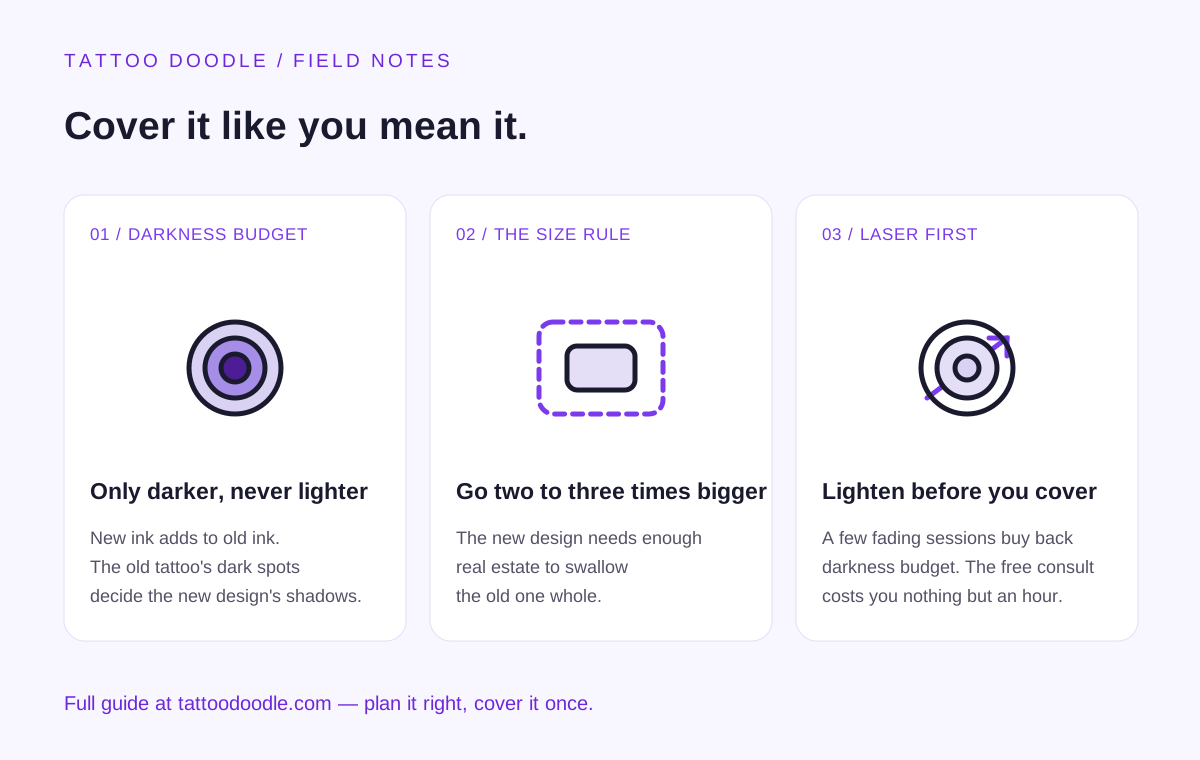
A successful tattoo cover up follows three non-negotiable rules: the new design can only go darker, never lighter; it must be two to three times the size of the old tattoo; and the old design's darkest areas dictate where the new design's darkest shading goes. Most cover-up disappointments come from fighting these rules instead of working with them — or from skipping the free laser consultation that could have loosened every constraint.
Almost every working tattoo artist has a cover-up specialty they did not ask for. Walk into any shop and you will see the same scene: a client angling an old tattoo toward the light, apologizing for it, asking some version of "can you make this go away?" The answer is almost always yes — but almost never in the way the client imagines.
A cover-up is not a deletion. It is a redirection. The old tattoo does not disappear; it gets absorbed into a new design the way a weak actor gets absorbed into a strong ensemble cast. Done well, nobody — including you — ever notices the old piece again. Done poorly, you end up with a bigger, darker tattoo you like less than the original. The difference between those two outcomes comes down to understanding what cover-ups actually are, mechanically. This guide is the honest version.
1. The Darkness Budget
Here is the single most important fact about cover-ups, and the one most clients misunderstand: a cover-up can only go darker, never lighter. Tattoo ink sits in the dermis, and new ink does not replace old ink — it mixes with it. You are not painting over a wall; you are adding more pigment to a layer that already has pigment in it. The combined result is always the sum of both.
I call this the darkness budget. Your old tattoo spent some of the skin's darkness budget already. Whatever remains is what the new design has to work with. A faded light-gray script left a big budget — almost anything can be built on top. A solid black tribal band spent nearly all of it — only the darkest, densest designs can absorb it, and even then the old shapes will ghost through in certain light.
This is why cover-up consultations often feel like the artist is being difficult when they say "not that." They are not being difficult. They are reading the budget. The most common budget mistake is wanting a light, airy, fine-line design over a dark old tattoo. That is asking the new ink to be lighter than what is already there — physics says no. Every cover-up artist has watched this exact disappointment happen, and every one of them would rather lose the booking than take a job the budget cannot support.
Before you even start browsing cover-up ideas, assess your own budget honestly: hold the old tattoo in bright natural light. The darkest parts of it are the floor. Your new design's darkest parts need to sit on top of the old design's darkest parts, and everything else needs somewhere to hide in the shadows the new design creates.
2. The Size Rule Nobody Can Negotiate
The second non-negotiable: a cover-up must be two to three times the size of the tattoo it covers. This is not upselling. It is geometry.
A cover-up works by distraction and absorption. The eye needs to land on the new design, not hunt for the old one hiding inside it. That requires the new piece to have enough visual real estate — enough bold shapes, enough dark areas, enough composition — to swallow the old tattoo whole. A design the same size as the old tattoo has nowhere to put the old tattoo. It just sits on top of it, and both designs end up visible, fighting each other.
If your old tattoo is two inches across, expect the cover-up to be four to six. If it is a quarter-sleeve, expect a half-sleeve or more. Artists who refuse to do small cover-ups are not being lazy; they are protecting you from a specific failure mode they have seen dozens of times: the client insists on same-size, the artist reluctantly agrees, and a year later the client is back asking to cover the cover-up.
This is the point in the process where you should make the real decision. If the size requirement feels like too much — if you do not actually want a piece that big — that is useful information. It means you might not want a cover-up at all. You might want laser removal, or a rework (more on both below). A cover-up you are talked into is just a second tattoo you regret, and those are the hardest ones of all to fix.
3. What Can Actually Cover What
Not all old tattoos are equally coverable. Here is the honest hierarchy, from easiest to hardest:
Easiest: faded, light, or old. Time is the cover-up's best friend. A fifteen-year-old tattoo that has softened into a gray blur is dramatically easier to cover than a two-year-old one, because fading freed up darkness budget. This is also why some artists suggest waiting a year or two before covering a fresh regret — the tattoo will soften, and your options widen. Patience is a legitimate cover-up strategy.
Medium: small, simple, lightly shaded designs. Old script, small symbols, light linework florals. These give an artist plenty of budget and plenty of placement options. A good artist can cover these with a wide range of styles.
Hard: large, dark, dense, or solid black. Tribal bands, blackout-adjacent pieces, heavy blackwork, dark portrait work. The budget is nearly spent. Covering these usually means going bigger, darker, and bolder — think blackwork, dark neo-traditional, heavy black-and-gray realism with deep shadows. The old tattoo will influence the new design's structure whether you want it to or not.
Hardest: cover-ups of cover-ups. Every layer of ink reduces the budget further. A tattoo that is already a cover-up is working with almost nothing. Many artists will decline these outright or insist on laser lightening first. If your tattoo is already a second-generation piece, skip straight to section 4.
What about color? Saturated color tattoos are harder to cover than black-and-gray of the same darkness, because the old color tints whatever goes over it — old reds and oranges bleed warm through new ink. But here is the counterintuitive part: adding color to the new design can help. Strategic color in the cover-up gives the eye somewhere to go and gives the artist more tools to break up the old shapes. A black-and-gray cover over a dark old tattoo is often harder to pull off than a colorful one.
4. Laser First: The Math Nobody Shows You
Here is the option most clients never hear about at the cover-up consultation, because the shop makes no money from it: laser lightening before the cover-up.
Full laser removal is expensive and slow — but you do not need full removal. You need fading. A few laser sessions can lighten an old tattoo dramatically, and lightening is what buys back darkness budget. Many laser clinics offer free consultations, and a typical lightening-for-cover-up plan runs far fewer sessions than full removal. The result: instead of being limited to dark, dense, triple-size designs, you can cover with something closer to what you actually want, at a size closer to what you actually want.
The honest math: if the cover-up you want requires going much bigger and darker than you are comfortable with, laser lightening is usually cheaper than the difference between the cover-up you want and the cover-up you settle for — and infinitely cheaper than a cover-up you regret and need to cover again. One consultation costs you nothing but an hour. I consider skipping it the most common avoidable mistake in the whole cover-up process.
A note on expectations: laser does not work equally on all ink. Black ink responds best; some colors (especially light blues, greens, and yellows) are stubborn. A reputable clinic will tell you this upfront during the free consult. If they promise total removal of a pastel watercolor piece in three sessions, get a second opinion.
5. Rework vs. Cover-Up: The Option You Forgot
Not every regretted tattoo needs covering. Sometimes the problem is not the tattoo — it is the execution. Faded lines, blown-out details, a design that was good on paper but got a sloppy translation. In those cases, ask about a rework (sometimes called a refresh or re-do): the same artist, or a better one, re-lines, re-shades, and tightens the existing piece.
Reworks are cheaper, smaller, and faster than cover-ups, and they preserve the tattoo you originally wanted. The catch is that the underlying design has to be worth saving. A rework cannot fix a concept you hate — it can only fix a concept that was executed badly. Be brutally honest with yourself about which problem you have. If you still like the idea and hate the result, rework. If you hate the idea itself, cover-up or laser.
There is also the middle path nobody talks about: addition. Sometimes the best cover-up is not a cover at all — it is expanding the old tattoo into a larger composition that absorbs it. The regretted butterfly becomes one element in a full floral sleeve. The ex's name gets swallowed by a larger scene. This works when the old tattoo is small and the new vision is big. It fails when the old tattoo is the thing you cannot stand looking at, because you will still see it every day, front and center in the new piece.
6. How to Pick a Cover-Up Artist
Cover-ups are a specialty, not a side skill. An artist who does beautiful original work is not automatically good at covers — the two require different thinking. Original work is additive; cover-up work is strategic. You need someone who thinks in darkness budgets.
What to look for:
- A portfolio full of cover-ups, with before-and-after photos. Not one or two — dozens. And critically, healed photos, not just fresh ones. Fresh cover-ups always look impressive; the truth shows up at six months, when you can see whether the old tattoo stayed buried.
- Honesty at the consultation. The right artist will tell you no sometimes. They will tell you when laser first would help. They will show you why your reference will not work on your specific old tattoo. An artist who agrees to everything is either a genius or a booking-taker — and geniuses are rare.
- Specialization evidence. Many cover-up specialists say so explicitly. If an artist's portfolio is all fine-line minimalism and you need a dark tribal band covered, that is the wrong artist no matter how good their linework is.
- A design process, not a flash pick. Good cover-ups are custom. The artist should be designing around your specific old tattoo — its shapes, its dark spots, its placement — not pulling a design off the wall and scaling it up.
Ask directly: "How many cover-ups have you done, and can I see healed photos?" Any good cover-up artist will light up at this question. Anyone who gets evasive just answered it.
7. The Honest Truth About Blast-Overs and Blackout
Two trends deserve honest treatment. Blast-overs — tattooing a bold new design directly over the old one without fully hiding it, letting the old piece ghost through as texture — are having a moment, and they are legitimately great for certain situations: old work you are at peace with but want to evolve, pieces where total concealment would require going unacceptably dark. The honesty required is that the old tattoo will show through. If that bothers you, it is not your style.
Blackout — covering with solid black — is the nuclear option, and I want to say something unfashionable about it: it is not a failure. The tattoo community sometimes treats blackout as giving up, as the thing you do when nothing else works. But a well-executed blackout, especially blackout with negative-space designs carved into it later, is a legitimate aesthetic choice with its own lineage. What it is not is reversible, easy, or something to choose while angry at the old tattoo. Sleep on blackout for a month. If you still want it, it was a decision. If the urge fades, it was a mood.
The Bottom Line
A cover-up is a bigger commitment than the tattoo it replaces — bigger in size, darker in ink, and harder to undo. That is not a reason to fear it. It is a reason to respect the process: understand your darkness budget, accept the size rule, get the free laser consult, and choose an artist who does covers the way a surgeon does operations — often, and on purpose.
The tattoo you regret taught you something about what you actually want. The cover-up is where you get to use that knowledge. Take the time to do it right, and the old tattoo stops being a mistake and starts being a story — one that nobody can see anymore, which is exactly the point.
FAQ
How much bigger does a cover-up need to be?
Plan on two to three times the size of the original tattoo. A two-inch old tattoo needs a four-to-six-inch cover-up. This is geometry, not upselling — the new design needs enough visual real estate to absorb the old one completely.
Can any tattoo be covered?
Almost any tattoo can be covered, but the constraints vary enormously. Faded, light, old tattoos are easy. Large, dark, dense pieces — and especially cover-ups of cover-ups — may require going much bigger and darker, or laser lightening first. An honest artist will tell you which category yours falls into.
Does a cover-up hurt more than a regular tattoo?
The pain is comparable to getting a tattoo of the same size in the same placement. Cover-ups often involve heavy shading and multiple passes over the same area, which can make sessions feel longer, but there is nothing inherently more painful about the process.
Should I get laser removal instead of a cover-up?
Consider laser lightening before the cover-up — not necessarily instead of it. A few sessions to fade the old tattoo buys back darkness budget and widens your design options dramatically. Many clinics offer free consultations, so the information costs you nothing.
How much does a tattoo cover-up cost?
Expect to pay for a custom piece two to three times the size of the original, at the artist's normal rate — cover-ups are custom design work, often with a longer consultation. Get the quote from the artist after they see the old tattoo in person; anyone quoting a firm price from a photo alone is guessing.
Can you cover up a scar with a tattoo?
Tattoos over scars are a separate specialty from cover-ups, and the rules differ: the scar tissue must be fully healed (usually at least a year old), and not all scar types take ink well. Some artists specialize in this. Do not assume a cover-up artist and a scar-cover artist are interchangeable — ask specifically.